
30 lines
1.3 KiB
Markdown
30 lines
1.3 KiB
Markdown
# Routing audio
|
|
|
|
One of my personal requirements for a _live coding_ system with SuperCollider is
|
|
that I want to route audio to other applications. I often use my _live coding_
|
|
system as a way to generate raw materials that go through various audio busses
|
|
for post-mixing and live audio effects controlled through MIDI controllers.
|
|
During the [setup](recommended.md) phase, I have encouraged you to install an
|
|
application that allows the creation of virtual audio busses. That's where it is
|
|
finally used.
|
|
|
|
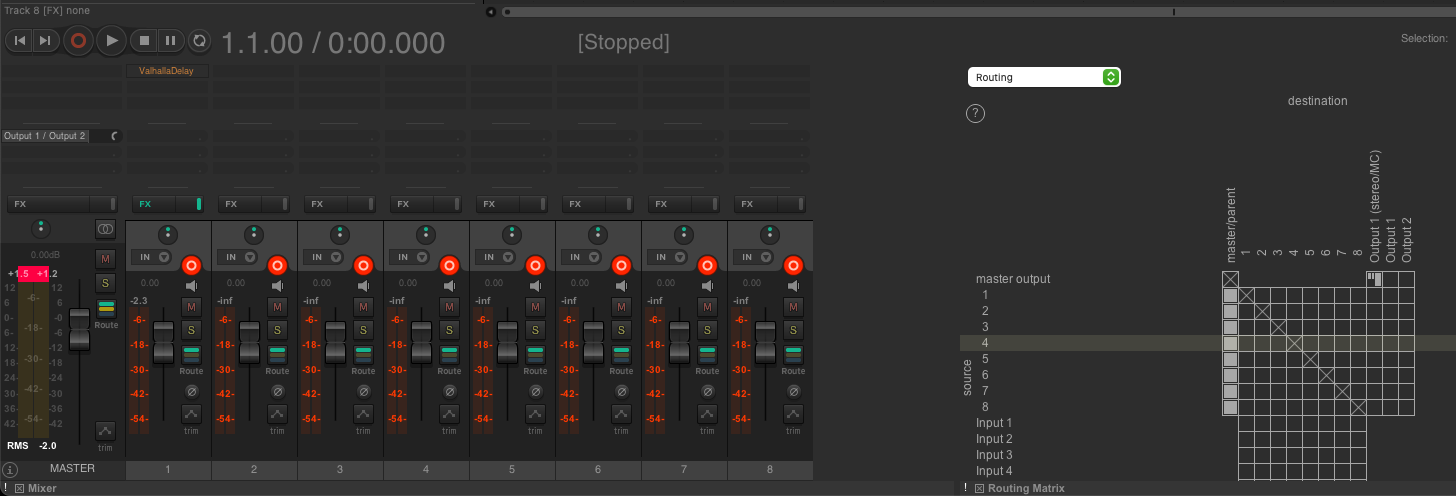
The `Boot` pseudo-class is seting up the audio to output to 16 channels. You can
|
|
think of it as 8 stereo channels with 2 channels each. If you like quadriphony
|
|
or octophony, you can also use 4 or 8 channels at a time. The routing of audio
|
|
in the host application is entirely up to you but the gest of it is that you can
|
|
now record / post-process the sound in any way you want.
|
|
|
|
|
|
|
|
# Sending audio to a bus
|
|
|
|
The `.play` method used by JITLib allows you to decide which output bus is going
|
|
to be used. All you have to do is to add some argument when calling the method:
|
|
|
|
```supercollider
|
|
~foo = { SinOsc.ar(200) ! 2 * 0.5 };
|
|
~foo.play(fadeTime: 4, out: 4);
|
|
```
|
|
|
|
This code snippet will play a sine wave on bus 5 and 6. Remember that the first bus is 0.
|